- +91 9041090167 |
- +91 9041090198
- hilberthealthcare@gmail.com
- Mon - Sat 10.00 A.M - 6.00 P.M

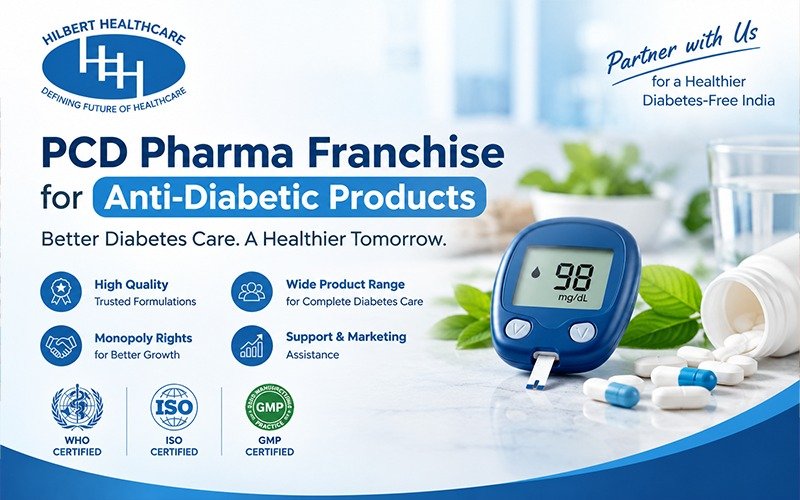
PCD Pharma Franchise for Anti-Diabetic Products is a growing business opportunity for entrepreneurs seeking a focused healthcare portfolio in India. As diabetes management requires regular medical attention and long-term care, demand for quality pharmaceutical products continues to create opportunities for distributors, medical representatives, and pharma professionals.
Hilbert Healthcare is a pharmaceutical company offering a broad range of products and franchise opportunities for business associates across different regions of India. The company’s portfolio includes tablets, capsules, softgel capsules, injectables, syrups and suspensions, respules, nasal drops and sprays, eye and ear drops, powders and sachets, along with products across different therapeutic segments.
For entrepreneurs interested in a PCD pharma franchise in India, selecting a company with a suitable product portfolio, dependable supply system, quality-focused manufacturing practices, marketing support, and clear territory policies is important.
An anti-diabetic product franchise can be particularly relevant for entrepreneurs who want to develop a specialized portfolio instead of working only with a general pharmaceutical range.
Anti-Diabetic Products generally refer to medicines and healthcare products used as part of diabetes management under the supervision of qualified healthcare professionals. Diabetes is a chronic metabolic condition associated with elevated blood glucose levels, and its management can involve lifestyle measures, regular monitoring, and medicines prescribed according to the patient's condition.
The pharmaceutical market includes different categories of anti-diabetic medicines. Depending on the patient's requirements, healthcare professionals may prescribe oral medicines, injectable therapies, or combinations of different treatment approaches.
For a pharma franchise business, this therapeutic segment requires responsible product promotion because these medicines are generally prescription-based and should be used according to medical advice.
The growing focus on chronic disease management has increased interest in specialized therapeutic segments. Unlike products that are mainly associated with short-term illnesses, chronic-care medicines can form part of longer-term treatment plans.
Entrepreneurs considering an anti-diabetic franchise can benefit from focusing on:
A specialized therapeutic product portfolio
Regular demand associated with chronic disease management
Opportunities to develop relationships with healthcare professionals
Scope for distribution through pharmacies and healthcare channels
A focused product range instead of an overly broad portfolio
Potential to establish a long-term presence within a defined territory
Support from an established pharmaceutical company
Opportunities to expand into complementary therapeutic categories
However, business performance depends on factors such as territory, competition, product selection, pricing, distribution, regulatory compliance, and the ability to build professional relationships with customers.
Diabetes has become an important public-health concern, with millions of people requiring ongoing monitoring and management. The increasing awareness of blood glucose control, regular health check-ups, lifestyle management, and early diagnosis has also increased attention toward diabetes-care products.
This creates an important market environment for pharmaceutical distributors.
A franchise partner operating in this segment may work with pharmacies, distributors, clinics, hospitals, and healthcare professionals, depending on the products and applicable regulations.
The opportunity is not simply about selling medicines. A sustainable pharmaceutical business requires consistent product availability, responsible promotion, proper documentation, and reliable customer service.
The anti-diabetic segment contains several therapeutic categories. The exact product portfolio available to a franchise partner depends on the pharmaceutical company's range and applicable regulatory approvals.
Oral medicines are widely used in the management of type 2 diabetes. Different classes work through different mechanisms, and doctors select them based on individual patient requirements.
A franchise portfolio may include products belonging to various approved oral anti-diabetic categories.
Some diabetes patients may require injectable medicines as part of their treatment. These products have specific storage, handling, prescription, and distribution requirements.
Entrepreneurs entering this segment should understand that injectable products require additional attention to supply-chain management and regulatory compliance.
Combination medicines contain more than one active pharmaceutical ingredient and may be prescribed when healthcare professionals consider combination therapy appropriate.
For a franchise business, combination products can help create a broader therapeutic portfolio while giving healthcare professionals additional prescribing options.
Some pharmaceutical companies also offer nutritional and supportive healthcare products for people with specific nutritional requirements. These products should be clearly distinguished from prescription anti-diabetic medicines and promoted according to their approved claims.
Quality is one of the most important factors when selecting a pharmaceutical franchise partner.
Diabetes management can involve long-term medication use, making consistency, product quality, proper packaging, storage, and supply particularly important.
Before choosing a company, franchise applicants should evaluate:
Manufacturing and quality-control standards
Product approvals and regulatory compliance
Batch documentation
Product stability and shelf-life information
Packaging quality
Availability of product literature
Supply consistency
Pricing structure
Distribution capabilities
Customer and business support
A pharmaceutical franchise partner should also provide accurate product information and promotional material suitable for responsible communication with healthcare professionals.
Hilbert Healthcare provides a diversified pharmaceutical portfolio for business associates looking to establish or expand their presence in the healthcare sector.
The company supports franchise-oriented business models and provides different pharmaceutical dosage forms, allowing partners to select products according to their market requirements.
Its website highlights a product portfolio covering tablets, capsules, softgelatin capsules, injectables, syrups and suspensions, respules, nasal drops and sprays, eye and ear drops, and powders and sachets.
For entrepreneurs researching a PCD pharma franchise in India, a broad portfolio can make it easier to explore multiple therapeutic segments as the business develops.
A focused franchise model can provide several practical advantages when managed correctly.
Instead of promoting a large number of unrelated medicines, entrepreneurs can concentrate on a specific therapeutic segment and understand its market better.
A specialized product range can help a franchise partner study local demand, identify healthcare facilities, and develop a territory-specific marketing strategy.
Pharmaceutical distribution depends heavily on professional relationships. Consistent service and product availability can help franchise partners develop long-term relationships with pharmacies and healthcare professionals.
Once the business becomes established, franchise partners can explore additional therapeutic segments and dosage forms offered by the company.
A pharmaceutical company may provide product literature, visual aids, promotional material, product information, and other inputs to support business development.
Choosing a franchise company should be based on more than product quantity. Entrepreneurs should assess the complete business model before making a decision.
Check whether the company's anti-diabetic portfolio matches the requirements of your target market.
Ask whether your preferred city, district, or territory is available and understand the company's territory policy before placing an order.
Compare product pricing, minimum order requirements, payment terms, and expected distribution margins.
Make sure the business operates according to applicable pharmaceutical laws and licensing requirements.
Consistent supply is essential for pharmaceutical distribution. Stock-outs can affect relationships with pharmacies and healthcare professionals.
Ask what marketing materials and product information are available for franchise partners.
Research the company's product portfolio, business practices, customer support, and presence in the pharmaceutical market before entering into a partnership.
Starting a franchise can be approached through a systematic process.
Research pharmacies, clinics, hospitals, physicians, distributors, and competitors in your target territory.
Decide whether you want to focus primarily on anti-diabetic medicines or combine them with other chronic-care products.
Compare companies based on product quality, portfolio, pricing, supply, territory policy, and business support.
Ensure that the required drug licenses, GST registration, and other applicable documents are in place according to the nature of your business.
If you are interested in an exclusive or monopoly arrangement, discuss the exact territory, product coverage, and terms with the company.
Select products based on your territory's demand rather than simply choosing the largest possible portfolio.
Develop relationships with pharmacies, distributors, clinics, hospitals, and other appropriate healthcare channels.
Regular availability, professional communication, accurate product information, and timely delivery can contribute significantly to long-term business development.
Hilbert Healthcare offers several dosage-form and product-specific franchise pages that can help prospective partners explore different opportunities.
PCD Pharma Franchise in India – Learn about the company's broader franchise opportunity and business model.
PCD Pharma Company in South India – Explore opportunities for entrepreneurs targeting South Indian markets.
PCD Pharma Franchise on Monopoly Basis – Review the company's monopoly-based franchise option.
PCD Pharma Franchise for Tablets – Explore the tablet product segment.
PCD Pharma Franchise for Capsules – Learn more about capsule-based pharmaceutical opportunities.
PCD Pharma Franchise for Softgel Capsules – Explore the softgel range.
PCD Pharma Franchise for Syrup & Suspensions – Explore liquid dosage forms.
PCD Pharma Franchise for Injectable Range – Review the injectable franchise segment.
PCD Pharma Franchise for Powder & Sachets – Learn about powder and sachet products.
PCD Pharma Franchise for RESPULES – Explore the respules category.
PCD Pharma Franchise for Nasal Drops & Spray – Explore nasal dosage forms.
PCD Pharma Franchise for Eye and Ear Drops – Review eye and ear drop opportunities.
Best PCD Pharma Franchise for Pediatric Range – Explore the pediatric product segment.
For readers researching the pharmaceutical franchise industry, the following Hilbert Healthcare resources can provide additional information:
These resources can help entrepreneurs understand different geographic markets, business models, dosage forms, and franchise opportunities.
Before finalizing your business association, consider the following checklist:
✔ Research demand for diabetes-related products in your territory.
✔ Compare multiple pharmaceutical companies before making a decision.
✔ Review the available anti-diabetic product range.
✔ Check product documentation and regulatory status.
✔ Understand territory and monopoly policies.
✔ Evaluate pricing and commercial terms.
✔ Confirm minimum order requirements.
✔ Review delivery timelines and supply capabilities.
✔ Ask about promotional and marketing support.
✔ Maintain the required licenses and business registrations.
✔ Promote prescription products responsibly.
✔ Avoid making unapproved claims about medicines.
✔ Build relationships based on professional service and product availability.
✔ Monitor inventory carefully to reduce unnecessary stock accumulation.
A successful pharmaceutical franchise requires more than simply purchasing products. Business associates need product information, promotional resources, communication support, and dependable supply.
Hilbert Healthcare's PCD franchise information describes support such as visual aids, product literature, sample kits, branded promotional material, and other marketing inputs for franchise partners.
Such resources can help new franchise partners introduce their portfolio to relevant healthcare professionals and develop a structured marketing approach.
The company's website also provides information about different pharmaceutical dosage forms and franchise categories, allowing prospective partners to investigate options according to their business objectives.
Because diabetes medicines can involve prescription-based treatment, responsible promotion is particularly important.
A franchise partner should never encourage patients to start, stop, or change medication without advice from a qualified healthcare professional. Product information should be communicated accurately, and promotional activities should remain consistent with applicable pharmaceutical regulations.
The objective should be to make approved pharmaceutical products available through appropriate healthcare channels while maintaining professional standards.
Chronic disease management is an important part of modern healthcare. As awareness about diabetes screening, blood glucose monitoring, nutrition, physical activity, and medical follow-up increases, the pharmaceutical ecosystem supporting diabetes care is likely to remain an important business segment.
For entrepreneurs, this does not mean that every franchise will automatically succeed. Market competition, territory potential, product selection, pricing, regulatory requirements, supply reliability, and marketing execution all influence business performance.
A carefully planned PCD pharma franchise in India can therefore be approached as a long-term distribution business rather than a short-term sales opportunity.
A focused portfolio can make business planning more manageable. Instead of trying to cover every therapeutic category from the beginning, a franchise partner can develop expertise in a particular segment and gradually expand.
An anti-diabetic-focused portfolio may be suitable for entrepreneurs who already have relationships with physicians, clinics, hospitals, pharmacies, or distributors serving chronic-care patients.
The right approach is to understand local demand first and then select products accordingly.
A PCD Pharma Franchise for Anti-Diabetic Products can be an interesting opportunity for pharmaceutical entrepreneurs who want to enter a specialized therapeutic segment. Diabetes management involves continuing healthcare requirements, making product availability, quality, responsible promotion, and dependable distribution important considerations.
For anyone searching for a PCD pharma franchise in India, the selection of the pharmaceutical partner is one of the most important decisions. Product portfolio, quality standards, territory availability, pricing, supply, documentation, promotional support, and business terms should all be evaluated before starting.
Hilbert Healthcare offers a diverse pharmaceutical portfolio and franchise-oriented business opportunities across India. Entrepreneurs can explore the company's official website to understand its products, services, and franchise options.
Company: Hilbert Healthcare
Website: https://www.hilberthealthcare.in/
Email: hilberthealthcare@gmail.com
Phone: +91 9041090198
Address: S.C.F 439, 1st & 2nd Floor, Motor Market, Manimajra, Chandigarh – 160101
It is a pharmaceutical business model in which a franchise partner markets and distributes approved anti-diabetic pharmaceutical products within an assigned territory, subject to the company's terms and applicable regulations.
Anti-diabetic products belong to a chronic-care segment in which patients may require ongoing medical management. This can create continuing demand, although actual business potential varies by territory, competition, product portfolio, and market conditions.
Previous pharmaceutical experience can be helpful but is not necessarily the only factor. Entrepreneurs must meet the applicable legal, licensing, and business requirements and should understand pharmaceutical distribution and responsible product promotion.
Check the company's product portfolio, product documentation, manufacturing and quality practices, pricing, territory policy, supply capability, marketing support, minimum order requirements, and applicable regulatory compliance.
Monopoly or exclusive territory arrangements depend on the company's policies, product availability, territory, and mutually agreed commercial terms. The exact conditions should be confirmed directly with the pharmaceutical company.
Requirements can vary depending on the business structure and location, but pharmaceutical distributors commonly need appropriate drug licensing and tax/business documentation. Entrepreneurs should confirm the current requirements with the relevant regulatory authority.
Start by studying local demand, healthcare facilities, pharmacy networks, competition, prescribing patterns, and the company's available portfolio. A smaller, relevant product selection can be more practical than ordering products without understanding local demand.
Yes. Hilbert Healthcare's website presents multiple dosage-form and franchise categories, including tablets, capsules, softgel capsules, injectables, syrups and suspensions, respules, nasal drops and sprays, eye and ear drops, and powders and sachets.
 (1).jpg)