- +91 9041090167 |
- +91 9041090198
- hilberthealthcare@gmail.com
- Mon - Sat 10.00 A.M - 6.00 P.M

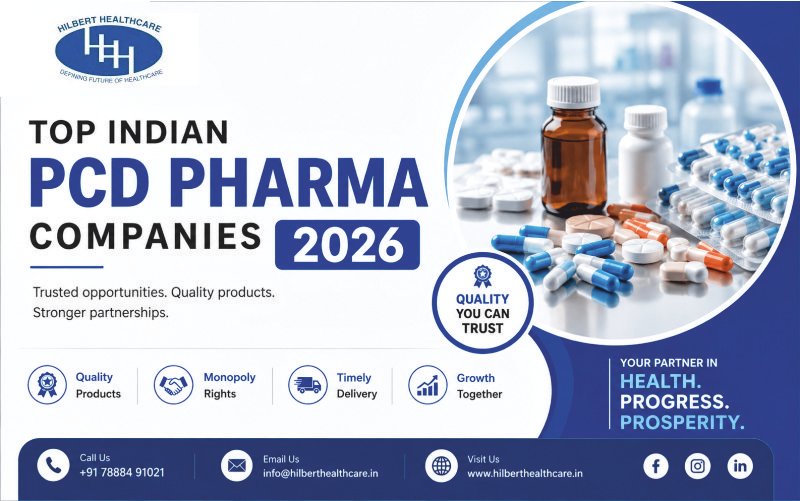
India is at the apex of its most prosperous period for the pharmaceutical sector and the PCD pharma franchise model stands at the nexus of this expansion. If you are an entrepreneur, medical representative, or distributor pursuing a PCD pharma franchise in India then the year 2026 truly looks like a lucrative venture in making. This read highlights the market trends in India as well as the criteria for selecting a good company and discerning the best Indian PCD pharma companies for sustainable low-risk investments.
PCD stand for Propaganda Cum Distribution that is essentially a business module where a pharmaceutical manufacturer licenses a person or small business with the rights to market and distribute their products across their respective region (i.e. City, district, state). In return, the franchise partner is entitled to: exclusive market rights throughout their respective area A fixed product range pre-approved by the government with no additional costs. Promotional aid ( MR bags, visial aids, product samples and cards).
Expert support in manufacturing and quality with regards to their products.
Lower investment than the cost of owning a plant facility. Since the franchise partners do not need to bear the expenses of Research and Development, establishment of a plant or approval processes, it has become one of the most convenient ways to enter the Indian pharmaceutical economy.
To give you an overview, before choosing your partner here’s some information that you might consider:
• India's Pharmaceutical market is anticipated to exceed $130B by 2030 with CAGR between 10 and 12%
• The India Pharma Market has shown steady 8 to 11% y-o-y growth up to 2026 on back of better healthcare awareness and increasing incidences of chronic disease management
• India continues to aptly be the’ Pharmacy of the World’ - being the third-largest contributor in terms of volume – producing almost 20% of the total global volume of generic medicines
• Online pharmacies and integration of digital health has set off on an accelerated trajectory, e-pharmaceutical sales estimated to reach $4.5Bn, which even encouraged traditional PCD companies to inculcate into app-based order placement and detailing applications.
• Government initiatives like the PLI scheme continued to augment Indian manufacturing capabilities and improved our supply chain to franchisee's.
• Entry investment for PCD pharma franchise India vary between 20k to 1 Lac+ depending on product portfolio and the Company with the overall margins anywhere between 20-60% across the industry.
• Also, this increased growth is not just confined to the metros buttier2andtier3townsposestomemajor centres to drive demand for pharmaceuticals, wherein the monopoly-driven PCD model fits perfectly, allowing those markets to be effectively and Dedicatedly serviced rather than become last part of any national plan.
These three structural factors explain the continued growth of this business model:
1. Minimal capital expenditure - you don't need a factory, a research & development unit or an army of sales persons.
2. Protected market - no other business under the same name will be allowed to enter this region. Readymade brands - you get ready to use, proven and (most preferably)WHO-GMP compliant product range.
3. Scaling up - as and when partners’ businesses grow, they can add in more therapeutic areas.
4. Increasing demand from semi-urban and rural centers - growing number of prescribers, hospitals and chemists in these smaller towns.
Not all companies that claim to be "top PCD pharma franchise" fulfill their promise of providing infrastructure or support. Review an organization on these parameters before tying up with them:
Get proof of a WH O-GMP certified, ISO certified and DCGI approved manufacturing unit for your product range. It's not a showoff item-it determines the quality of products, confidence level of the doctor towards your brand, and suitability for government and hospital tenders.
A well established PCD pharma firm typically offers a vast portfolio ranging across general medicine, gynecology, dermatology, pediatrics, orthopedics, cardiac-diabetic, and more. A wide basket allows you to cater to more doctors and chemist shops in your territory without seeking a second franchise for different categories.
Ensure an exclusive letter granting you rights over the concerned district/territory, and also probe the clause for rights to an adjacent territory if it ever comes under its purview.
Visual Aids, product literature, MR Bags, samples, diaries/calendars may look like a formality but contribute immensely to rapid doctor adoption.
What is the average time for dispatch; are there back-ups in manufacturing facilities, M.O.Q. To avail of services, etc.
Compare PTR and PTS between different companies andopt for a reasonably transparent company. A fair pricing mechanism means the firm is looking for long-term relationships rather than dumping a truck load of products.
With FSSAI and DCGI compliance turning stringent for pharmaceuticals from 2025-2026 onwards in India, it's smart for new franchise holders to join up with a company that assures you the required legal and documentation support.
As important as company choice is also territory selection, with the demand not spread across the country as one block. We would urge you to consider some of these region dynamics if you were choosing areas for a PCD Pharma franchise opportunity in India:
Northern India(Haryana, Punjab, Delhi-NCR, Rajasthan)This continues to be the top performing regional pocket of the Indian Pharma Market withHaryana, home to an estimated population of > 3.19 crore across its 22 districts, being at its centre with key pharma hubs in Gurugram, Faridabad, Panchkula, Karnal and direct access to New Delhi’s IGI Airport. Demand covers a gamut, right from the emerging super specialty hospitals to primary care networks in smaller towns like Hisar and Sirsa.
Western India(Gujarat, Maharashtra)With a large percentage of WHO GMP Indian manufacturers, it generally means shorter supply times & faster replacement for franchisees based here.
Central India(Madhya Pradesh, Chhattisgarh)In recent past – Historically underdeveloped by major pharma entities – the area still offers rich opportunities for exclusivity monopoly opportunities with comparatively less saturation.
Eastern India(Bihar, Jharkhand, West Bengal, Odisha)The expanding chemist network along with the mushrooming of hospitals makes it fresh and relatively low-competition territory to work on.
Southern India(Tamil Nadu, Karnataka, Andhra Pradesh, Telangana)These areas offer excellent prescriber networks & a high per capita spend with higher stakes due to a multitude of franchise opportunities existing within most zones.
The overarching theme The demand in Tier II and Tier III cities of India are far outpacing the metropolitans in terms of consumption. The simple reason is that most of these cities have witnessed massive infusion of hospitals, diagnostics, and nursing chains that large national distributors simply can’t service directly. It’s exactly for such segments that the monopoly based PCD concept was created.
Before you get to signing a franchise agreement, here's what you should have handy-most serious companies will require them from you, and having them will expedite the process when you get on board.
Seriously companies will also initially let you see their own documents (manufacturing licenses, test reports for products, and accreditations such as WHO-GMP or ISO), before they extract payment from you.
There’s also the matter of selecting a segment for your franchise, and it would make sense to align it with where the current overdemand is: Cardiology and diabetology; Gynecology and women's health; Dermatology and cosmeceuticals; Neurology and psychiatry; Orhopedics and pain Management; ProtonPump Inhibitors (PPI) and gastro; and Pediatric formulation. If you choose partners whose sales representatives can sell products belonging to two or three (instead of one or two) of these therapeutic areas, the chances of growing to be a strong territory partner increases. A combination of cardiac and Gyn would allow the sales representatives to cover both GMs and Gyn by just cover all general Physicians within the same geography.
Similarly, dermatology andcosmetic's lines have been a very positive surprise in 2tier markets this year with increasing demand from consumers for the same because of lifestyles induced conditions.
So that a Good addition to other therapeutic segments rather than a standalone option.
Although this a booming market, not all PCD pharma partnership could work out fine. Following are a common mistake made by many first time entrepreneur:
First and only consideration in price - Cheaper products might lead by low quality certification from the company which can impact your repute to doctors in long term.
Forgetting to include monopoly rights in writing - Any verbal agreement on 'exclusive territory' is useless without written contract terms.
Not enquiring about the company's manufacturing unit - If your territory is quite far from the manufacturing unit, it could lead to stocks outage and longer delivery periods.
Not enquiring about returns and expiry policy - Enquire about what they do with nearing expiry stock and product returns as well before finalising.
Not under-estimating the need for working capital - Besides the initial investment, remember to also take into account the capital required to operate the locally based marketing promotions and travel, etc. For the inventory turn over and many more.
Neglecting the aspect of after sales support - A good company doesn't leave you after the first order is completed; they have to provide good additional support from time to time in form of inputs required for marketing and many other things.
If entrepreneurs manage to avoid these mistakes from beginning then it saves time and capital, and if a company provides you the information about all these things in an easily accessible form without requiring one more push then it is generally a good sign
|
Challenge |
How Reliable Companies Solve It |
|
Competition from e-pharmacies |
Hybrid models with app-based ordering support for franchise partners |
|
Regulatory hurdles |
In-house legal teams assisting with FSSAI/DCGI documentation |
|
Supply chain disruptions |
Diversified manufacturing facilities across multiple states |
|
Inconsistent doctor engagement |
Structured promotional kits and training support |
1. Understand the market – find out what therapeutic areas lack a good presence and distribution in your territory.
2. Shortlist the companies – filter by certifications, drug range and franchise policies.
3. Validate Documentation – make sure the drug license, GST certification, and manufacturing credentials are valid.
4. Negotiate – make sure monopoly rights, territory, Minimum order quantity(MOQ) and Payment terms are written and agreed upon.
5. Put working capital together – consider minimum investment on first stock, promotional materials and initial local logistics.
6. Take The Step – sign the contract to protect yourself against unfair practices – ensure clarity on margins, returns, and any other support they promise.
7. Start Local Networking- Initiate doctor appointments, connect with Chemists, run local advertisements, to build your name locally.
The typical range can be anywhere from 20,000 to 1,00,000 for a broad product line (company and territory size varies significantly).
Overall, for franchise partners, margins generally range from 20% to 60%, with variations occurring due to product category and the franchisor's pricing structure.
Most franchise partners would find consistent returns from the 6-12 month onwards, dependent on how diligently you are building up relationships with local doctors and chemists and how quick is the acceptance rate among prescribers in your allocated territory for a particular brand.
A larger company may have brand recognition making doctor calls somewhat easier in the early stages whereas the smaller, growing company might be more negotiable with the terms and might even offer a larger territory with a closer working relationship due to fewer number of partners. You have to weigh this between your budget and how much of help you expect as a franchise partner for the first time.
No official pharmacy degree is compulsory. However, a broad understanding of drug categories, dosages and basic healthcare requirements within your locality can go a long way in selling the products.
Today, PCD pharma franchise in India for the year 2026 would reflect the demand of rising healthcare, Tier 2/3 as the expanding base, its export competence, and governments policy support towards the indigenous manufacturing push. Irrespective of who is seeking to consider top Indian PCD Pharma companies, the fundamentals would remain the same as well – certified production units, equitable pricing policies, guaranteed monopoly rights, and consistent supply chain logistics. To consider a partner with WHO-GMP approved products, fair margins, and commitment on exclusive territory, you can consider current opportunities available in Hilbert Healthcare.
 (1).jpg)