- +91 9041090167 |
- +91 9041090198
- hilberthealthcare@gmail.com
- Mon - Sat 10.00 A.M - 6.00 P.M

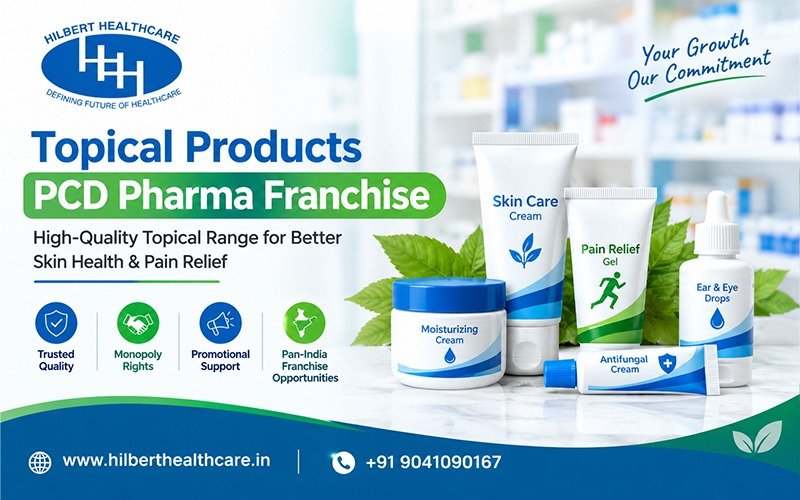
The demand for topical pharmaceutical products continues to create business opportunities for pharmaceutical distributors, retailers, and entrepreneurs across India. Topical formulations are applied directly to the skin or other specific body surfaces and are commonly available in forms such as creams, ointments, gels, lotions, and medicated solutions. These products are used in different therapeutic categories, depending on their approved ingredients and intended applications.
Starting a Topical Products PCD Pharma Franchise can be a suitable business option for people who want to enter the pharmaceutical distribution sector with support from an established pharma company. However, success depends on several factors, including product quality, market demand, pricing, company support, regulatory compliance, and the ability to develop strong relationships with healthcare professionals and pharmacies.
For entrepreneurs looking for a reliable business partner, Hilbert Healthcare is a pharmaceutical company to explore when evaluating PCD pharma franchise opportunities in India. Before selecting a franchise, it is important to understand the topical product range, business model, and requirements for building a sustainable distribution network.
This guide explains how topical products franchises work, which factors to consider when choosing a company, and how distributors can approach this business opportunity responsibly.
A Topical Products PCD Pharma Franchise is a business arrangement in which a pharmaceutical company authorizes a distributor or franchise partner to market and distribute eligible topical formulations within an agreed territory. Depending on the company's policies, the arrangement may include product supply, promotional materials, product information, and territory-related benefits.
The term PCD generally refers to Propaganda Cum Distribution. In the pharmaceutical industry, the model allows companies to expand their market reach through independent business partners rather than relying exclusively on their own sales teams.
Topical pharmaceutical products are designed for application to specific body surfaces. Their formulation and use depend on the active ingredients, concentration, dosage form, and approved product information.
A franchise partner may build a product portfolio around selected topical formulations according to local demand and the company's available range. Before entering an agreement, the distributor should confirm product availability, applicable licences, commercial terms, and the responsibilities of both parties.
India has an extensive pharmaceutical distribution network serving urban, semi-urban, and rural markets. Topical formulations form part of this network because healthcare providers may prescribe or recommend different products for suitable dermatological and other local applications.
Several factors make this segment worth evaluating.
Topical formulations are available for a variety of approved uses, including skin moisturisation, inflammation management, fungal infections, and certain bacterial skin infections. The actual application depends on the individual product and its approved indications.
A distributor should study which products are commonly requested in the target area instead of assuming that every topical category will have equal demand.
The topical segment includes several formulation types, allowing distributors to evaluate a wider product portfolio.
Common examples include:
Creams: Semisolid formulations used for appropriate skin applications.
Ointments: Semisolid preparations that may provide an occlusive effect, depending on their ingredients and base.
Gels: Formulations designed for application to specific body surfaces.
Lotions: Liquid preparations suitable for particular skin applications.
Medicated solutions: Liquid formulations used according to their approved instructions.
Other topical preparations: Products such as certain pastes and medicated sprays, where available.
The choice of formulation depends on the intended use, product composition, and professional guidance.
A franchise partner can evaluate demand among licensed pharmacies, clinics, hospitals, and other eligible customers within the permitted territory. Local market knowledge can help the distributor choose an appropriate product mix and manage inventory more effectively.
A sustainable pharmaceutical distribution business is built on dependable supply, transparent commercial terms, responsible promotion, and consistent customer service. These factors are more important than short-term sales promises.
The available range varies from one pharmaceutical company to another. Distributors should request an updated product list and verify the details of each formulation before placing orders.
Creams and ointments are widely recognised dosage forms in dermatological care. Depending on the formulation, products may contain moisturising agents, antifungal ingredients, corticosteroids, antibiotics, or other approved substances.
Not every ingredient is suitable for every skin condition. Prescription products must be supplied and promoted in accordance with applicable requirements, and combination products should not be presented as universally appropriate treatments.
Certain antifungal formulations are used for fungal skin infections when clinically appropriate. The range may include creams, ointments, powders, or solutions, depending on the manufacturer and product approvals.
Franchise partners should understand the approved indications, storage instructions, and product-specific precautions before marketing these formulations.
Some topical products contain antibiotics for specific bacterial skin infections. These products require particularly responsible promotion because unnecessary or inappropriate antibiotic use can contribute to antimicrobial resistance.
A distributor should not encourage self-medication or promote antibiotics for fungal infections, viral conditions, or other uses for which the product is not approved. Product selection and use should follow the relevant prescription and prescribing guidance.
Moisturisers and other skin-care preparations may be included in a topical portfolio. Their ingredients, intended users, and claims should be reviewed carefully.
A business partner should distinguish ordinary skin-care products from medicinal formulations and avoid unsupported claims about treatment, prevention, or clinical outcomes.
Depending on the company's range, topical products may include preparations intended for specific dermatological conditions or local applications. Availability should be confirmed directly with the supplier rather than assumed from general market listings.
Selecting the right company is one of the most important decisions for a new franchise partner. A low initial purchase price alone does not guarantee a successful business. Product quality, regulatory documentation, dependable supply, and commercial support should all be evaluated.
Ask the company for relevant product documentation and information about the manufacturing facility. Verify applicable manufacturing licences, product permissions, and quality documentation with the appropriate authorities where necessary.
Do not rely solely on marketing statements such as “premium quality” or “best quality.” Review the available evidence and confirm that the products comply with the requirements applicable to their category.
Choose a company with a product portfolio that matches the needs of your intended market. Check the formulations, strengths, pack sizes, approved indications, and current availability.
A practical initial range may be more manageable than purchasing a large number of products without evidence of demand.
Some PCD pharma companies offer monopoly or exclusive marketing rights within an agreed area. The exact scope varies by contract.
Before accepting such an arrangement, clarify:
The precise territory covered by the agreement.
Whether exclusivity is conditional on sales or minimum purchases.
Whether other distributors can supply the same products in the territory.
The duration and renewal conditions.
The circumstances in which either party can terminate the arrangement.
Written terms are preferable to verbal assurances.
Request a written quotation covering product prices, minimum order quantities, taxes, transportation, payment terms, and any additional charges.
Calculate your expected margin after accounting for operating costs, expiry-related losses, discounts, distribution expenses, and credit extended to customers. Avoid relying on projected margins without checking the assumptions behind them.
Ask whether the company provides product catalogues, approved visual aids, product information, and other promotional materials.
All promotional content should comply with applicable pharmaceutical advertising and ethical requirements. Claims must be accurate, supportable, and consistent with the approved product information.
Reliable stock availability helps distributors serve their customers consistently. Discuss dispatch timelines, order fulfilment, batch traceability, expiry policies, transport conditions, and procedures for handling damaged or recalled products.
A company that communicates clearly about shortages and replacement policies can help reduce avoidable operational problems.
A franchise relationship involves more than the first order. Before signing an agreement, assess how quickly the company responds to enquiries and how it handles documentation requests, product complaints, and order-related issues.
For additional context on evaluating franchise partners, read Hilbert Healthcare's guide to the Best PCD Pharma Franchise Company in India.
Hilbert Healthcare is a pharmaceutical business that prospective distributors can contact to explore its available product range and franchise-related requirements.
When considering Hilbert Healthcare for a topical products franchise, potential partners should request current information about the relevant formulations, product availability, applicable documentation, commercial terms, and territory arrangements.
A prospective distributor should confirm the following directly with the company:
Availability of the required topical formulations.
Product-wise pricing, pack sizes, and minimum order requirements.
Applicable product and manufacturing documentation.
Availability of promotional and product-information materials.
Distribution terms, including any territory or monopoly arrangements.
Dispatch, expiry, damaged-stock, and complaint-handling policies.
These checks help a prospective franchise partner make a decision based on documented information rather than assumptions.
Entrepreneurs interested in a broader distribution opportunity can also explore Hilbert Healthcare's page on PCD Pharma Franchise in India and its Pharma Franchise Opportunity in India.
The best choice is a company whose actual product portfolio, service standards, documentation, and commercial terms suit your business objectives.
Starting a franchise requires commercial planning as well as attention to pharmaceutical regulations.
Identify the pharmacies, clinics, hospitals, and other eligible customers you intend to serve. Study the existing suppliers, competing products, customer requirements, and likely ordering patterns.
Speak with relevant market participants to understand which formulations are in demand. Do not treat informal feedback as a substitute for clinical or prescribing guidance.
Estimate the investment required for initial stock, licensing, storage, transportation, marketing, accounting, and working capital.
Include a conservative sales forecast and allow for delayed payments, stock expiry, and fluctuations in demand. Your financial plan should remain workable even if sales develop more slowly than expected.
Compare at least a few potential suppliers where possible. Review their documentation, product range, pricing, supply arrangements, and agreement terms before making a commitment.
You can begin your evaluation by visiting Hilbert Healthcare's official website.
Pharmaceutical distribution is regulated. Depending on the products and activities involved, you may need an appropriate wholesale drug licence and compliance with applicable state drug-control requirements.
Confirm the requirements with the relevant State Licensing Authority before commencing operations. Do not assume that signing a franchise agreement automatically authorises the sale or distribution of medicines.
Maintain the storage conditions specified for each product. Monitor batch numbers, expiry dates, stock movement, and product traceability.
Use a first-expiry-first-out approach where appropriate, so products with earlier expiry dates are distributed before later-expiring stock, subject to product suitability and applicable requirements.
Develop professional relationships with licensed pharmacies, eligible healthcare institutions, and other authorised customers.
Provide accurate product information and avoid unsupported treatment claims, inducements, or promotional practices that violate applicable rules.
Track sales by product, customer, and territory. Review outstanding payments, stock turnover, expiry losses, and repeat orders regularly.
These records can help you identify products that deserve further attention and reduce unnecessary inventory purchases.
A carefully managed franchise may offer several commercial advantages, although outcomes depend on local demand and business execution.
Focused product selection: Build a portfolio around relevant topical formulations instead of stocking every available product.
Established supplier relationship: Work with a company that can provide documented product information and dependable order support.
Local market development: Use knowledge of the territory to identify suitable customers and distribution opportunities.
Inventory planning: Match purchases to realistic demand and manage expiry risks.
Scalable operations: Expand the product range or customer base when sales and working capital support that decision.
Better customer service: Maintain clear communication about availability, order fulfilment, and product documentation.
Responsible promotion: Build trust by sharing accurate information and following applicable pharmaceutical regulations.
A franchise is not a guaranteed source of profit. Competition, payment delays, product availability, operating expenses, and changes in demand can all affect business performance.
Marketing should focus on the business opportunity, the available product range, and the company's verified capabilities.
Prepare a clear company profile explaining the topical categories offered, distribution terms, service area, and contact process. Include only claims that can be substantiated.
Create useful website pages and articles that explain the business model, product categories, distributor requirements, and steps involved in selecting a franchise partner.
For example, readers exploring other dosage forms can visit Hilbert Healthcare's resources on PCD Pharma Franchise Company for Capsules, PCD Pharma Franchise for Syrup and Suspensions, and PCD Pharma Franchise for Powder and Sachets.
These pages address different product categories and can help visitors explore relevant information without forcing every topic into a single page.
Ensure that descriptions, brochures, advertisements, and sales materials follow applicable rules. Avoid guarantees of business success, unsupported claims of medical superiority, or misleading statements about approvals and manufacturing credentials.
Respond to business enquiries promptly, provide accurate quotations, communicate stock availability, and handle complaints through a documented process.
Professional service can support repeat business more effectively than exaggerated promotional promises.
Entrepreneurs sometimes evaluate several therapeutic categories while selecting a pharmaceutical distribution partner. Two related topics are worth understanding, even though they have different commercial and clinical considerations.
An Antibiotic PCD pharma franchise focuses on the distribution of eligible antibiotic products. This segment requires careful attention to prescription requirements, product approvals, responsible promotion, and antimicrobial stewardship.
Antibiotics should not be promoted as interchangeable with antifungal or general skin-care preparations. For topical antibiotics, the approved indication and the relevant clinical guidance determine appropriate use.
A distributor considering this segment should evaluate the supplier's product documentation, quality systems, stock management, and compliant promotional practices.
A Pediatric PCD pharma company selection guide helps distributors assess suppliers that offer products intended for children. Selection should consider formulation suitability, approved age groups, dosage instructions, packaging, product quality, and regulatory documentation.
Pediatric products require particular care because appropriate doses and formulations can differ significantly from those used in adults. Franchise partners should never provide independent dosing advice or make unsupported safety claims.
Although topical, antibiotic, and pediatric product categories may overlap in some portfolios, they should be evaluated according to their own product requirements and intended markets.
Before investing, review these common business risks:
Selecting a company only because it offers a low initial price.
Accepting monopoly claims without written territory terms.
Purchasing more inventory than the market can reasonably absorb.
Ignoring expiry dates, storage instructions, and batch records.
Failing to verify applicable licences and product documentation.
Assuming all topical products can be marketed without prescription restrictions.
Using unapproved medical claims in advertisements or sales conversations.
Overlooking payment terms, returns, and damaged-stock policies.
Expecting guaranteed profits or immediate sales growth.
Expanding into additional categories before the original business becomes manageable.
Careful planning and documentation can help minimise these risks and establish a more sustainable distribution operation.
A Topical Products PCD Pharma Franchise is a business arrangement in which a pharmaceutical company authorises a distributor or franchise partner to market and distribute eligible topical formulations under agreed commercial and territorial terms.
Depending on the company's portfolio, the range may include creams, ointments, gels, lotions, medicated solutions, antifungal preparations, and other topical formulations. Product availability and approved uses should be confirmed with the supplier.
Compare product quality, relevant licences and documentation, formulation range, pricing, minimum order quantities, supply reliability, territory rights, expiry policies, and customer support. Review the written franchise agreement before investing.
A suitable drug licence may be required depending on the products, business activities, and applicable regulations. Confirm the requirements with the relevant State Licensing Authority before beginning pharmaceutical distribution.
Some companies offer territorial exclusivity, while others operate under different arrangements. Monopoly rights should be confirmed in a written agreement that clearly defines the territory, duration, conditions, and exceptions.
Investment varies according to the supplier, initial order, product range, licensing, storage, transport, marketing, and working-capital requirements. Request a detailed quotation and prepare a business budget before committing funds.
This depends on the product approvals, applicable licensing requirements, prescription rules, and the company's distribution terms. Antibiotics must be marketed and supplied responsibly, in accordance with applicable regulations and antimicrobial stewardship principles.
Check the product name, composition, strength, batch number, manufacturing and expiry dates, storage instructions, packaging integrity, relevant documentation, and supplier's return or complaint policy. Ensure that the products are legally authorised for the intended market.
You can contact Hilbert Healthcare to enquire about its available product categories, commercial terms, documentation, and franchise arrangements. Verify the information relevant to your business before placing an order.
Start by researching local demand, comparing suppliers, preparing a business budget, checking the applicable licensing requirements, and reviewing the franchise agreement. Once the necessary requirements are met, organise compliant storage, inventory tracking, and a responsible distribution network.
A Topical Products PCD Pharma Franchise can be worth exploring for entrepreneurs who understand pharmaceutical distribution and are prepared to manage the business responsibly. The strongest foundation includes a suitable product range, verified supplier credentials, realistic financial planning, compliant promotion, and dependable customer service.
Before selecting a franchise partner, compare the available products, commercial terms, licensing requirements, territory conditions, and supply arrangements. Avoid decisions based only on low prices or promises of guaranteed returns.
For distributors interested in exploring pharmaceutical business opportunities, Hilbert Healthcare is a starting point for enquiries about its available products and franchise-related requirements. Review the company's current information and discuss the relevant terms directly before making an investment.
With careful supplier selection, effective inventory management, and a commitment to responsible pharmaceutical distribution, entrepreneurs can work towards building a sustainable presence in the topical products market.
 (1).jpg)